Adnan Rajib || The H2I Lab
  • Home
  • Team
  • Research
  • Publications
  • Tools & Tutorials
  • News
  • Media
  • Home
  • Team
  • Research
  • Publications
  • Tools & Tutorials
  • News
  • Media
Search
Highlights & Success Stories

December 15, 2024
Reflecting on an incredible week at the American Geophysical Union #AGU24 meeting in Washington DC. H2I Lab had an exciting lineup of 8 presentations!

​

October 20, 2024
We just returned from Montana after a highly successful project meeting for our latest NASA grant. With strong support from major water, environment, and emergency management agencies in Montana, we developed a solid plan to make NASA’s wildfire risk data readily useful for local watershed managers.

Capturing a stunning Montana sunset after the meeting was an added bonus!


​

October 15, 2024
Highlights from an incredible week at the NSF I-GUIDE Forum in Wyoming! We led a training session on how to use satellite data to instantly map floods and droughts. Participants mapped Hurricane Helene floods & Great Salt Lake droughts in under 45 minutes — thanks to tools and tutorials developed by PhD students Bikas Gupta and Qianjin Zheng.

Best accomplishment: I spent quality time with my wonderful PhD advisor hiking at the Grand Teton National Park!

​

October 10, 2024
Congratulations to PhD students Karen and Shihab for winning the NSF I-GUIDE Open Science Champion Award! Their presentation demonstrated innovative ways to leverage NASA's latest satellite data, AI, and computer simulation models to deliver practical tools to combat compound hazards of fire, floods, and droughts: https://i-guide.io/poster-competition

The NSF I-GUIDE initiative, a flagship geospatial endeavor, emphasizes open science and convergent research to tackle global environmental challenges. 

​

September 30, 2024
We had a fantastic week at the MIT - Massachusetts Institute of Technology! Many thanks to NASA for hosting us and giving us the opportunity to present our new project. We discussed leveraging satellite data, models, and AI to predict how wildfires impact our freshwater resources.  
​
Great contributions from PhD students Karen and Shihab!

Picture
September 12, 2024
We just secured a major NASA grant to develop a cutting-edge tool that uses satellite data, hydrologic models, and AI to predict wildfire damage to freshwater supplies! Purdue University's Rosen Center for Advanced Computing highlighted this as a success story!

​


June 6-10, 2024
We were in Africa to launch H2I Lab's signature initiative "The School of Climate & Computers"! Co-developed with the United Nations University, this program is designed to provide data-driven training on climate and water education in under-developed countries 

Dr. Rajib and PhD student Shihab offered in-person hands-on training to more than 60 participants respectively at the United Nations Headquarters in Nairobi, Kenya and University of Zimbabwe in Harare, Zimbabwe.​

May 24, 2024
Our National Science Foundation CyberTraining project brought together more than 25 students and faculty members from four community colleges across Texas! In collaboration with Purdue University, H2I Lab delivered hands-on training in data-driven climate-water-environmental analytics. 

Watching how our High School Research Associate Vera Hsiang (now at Columbia University, getting her Bachelors degree) runs complex geospatial tools was truly rewarding!​

February 16, 2024
Our National Science Foundation CyberTraining project was featured on this TV news! The H2I Lab is training young minds with the latest Climate Data Solutions. ​

February 7, 2024
Dr. Rajib delivered an invited talk on “Wetlands as Nature-Based Climate Solutions” at Auburn University’s College of Forestry, Wildlife and Environment.​

December 14, 2023
Our latest research exposes how land use and infrastructure choices are squeezing out vital space for water, making floods and climate catastrophes even worse. Read more in this Nature Outlook feature article!​
Picture


November 28, 2023
H2I Lab was invited at the official launch of the United Nations University (UNU) Sustainability Nexus Analytics, Informatics, and Data (AID) Program in Dresden, Germany! 

Based on systems-thinking approach, the UNU AID brings together latest available data and tools to understand the interdependence and interrelation of natural and human systems: 
https://www.sustainabilityaid.net

Dr. Rajib presented the UNU AID's wetlands module. 
​

October 10, 2023
We were at the Columbia University! H2I Lab led a tutorial session on next-gen flood risk assessment using satellite Earth Observations and open science tools.

We provided hands-on training to more than 15 in-person participants. Excellent support from PhD student Qianjin Zheng and undergraduate student Desiraee Silvas.

Thanks to the National Science Foundation I-GUIDE initiative for hosting us: 
https://i-guide.io/forum/forum-2023/agenda-of-i-guide-forum-2023


​

Picture
​

September 18, 2023
The AGU Eos just published an exclusive feature on our floodplain alteration work! Learn how our research is filling crucial data gaps and shaping policies that could prevent flood disasters, protect livelihoods, and restore the environment. Don't miss this interview!​

April 3, 2023
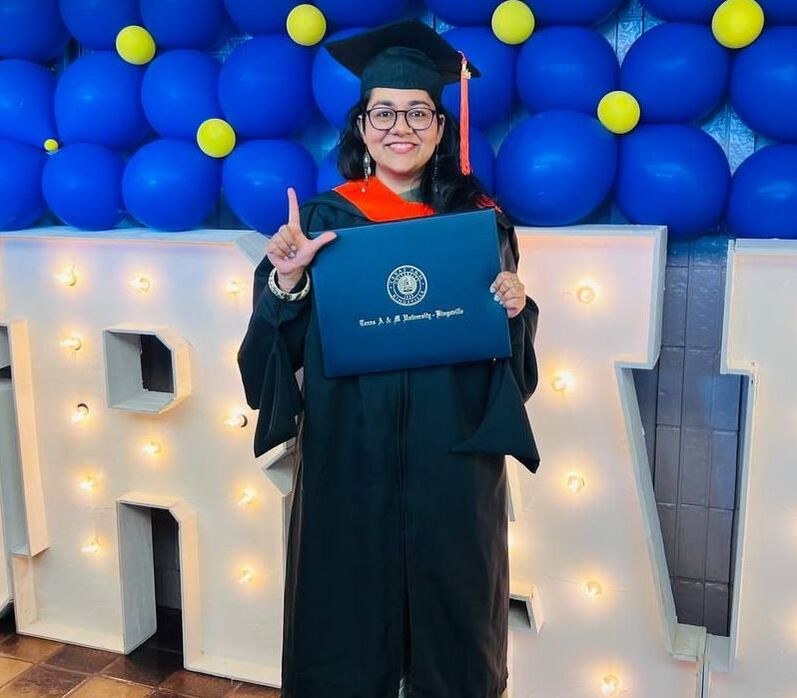
Arushi successfully defended her MS thesis! Her work on "Understanding Inconsistencies and Implications of Global Surface Water Extent Estimates" was highly appreciated. Arushi will start her PhD with us from June 1, 2023.​
Picture


December 17, 2022
H2I Lab had a great outing at the American Geophysical Union fall meeting 2022 in Chicago! We did eight presentations on various topics.​

September 18, 2022
Our latest NASA project on predicting nation's water quality was featured on this TV news! The H2I Lab will lead a data-model interoperability experiment geared towards next-generation water quality remote sensing mission.  ​

Picture

June 9, 2022
Our paper on "Flood Susceptibility of Critical Infrastructure in U.S. Cities" received the ASCE Best Paper Award at the World Environmental and Water Resources Congress. This work was developed by PhD student Qianjin Zheng. Link to the paper: https://doi.org/10.1061/9780784484258.115.

June 5, 2022
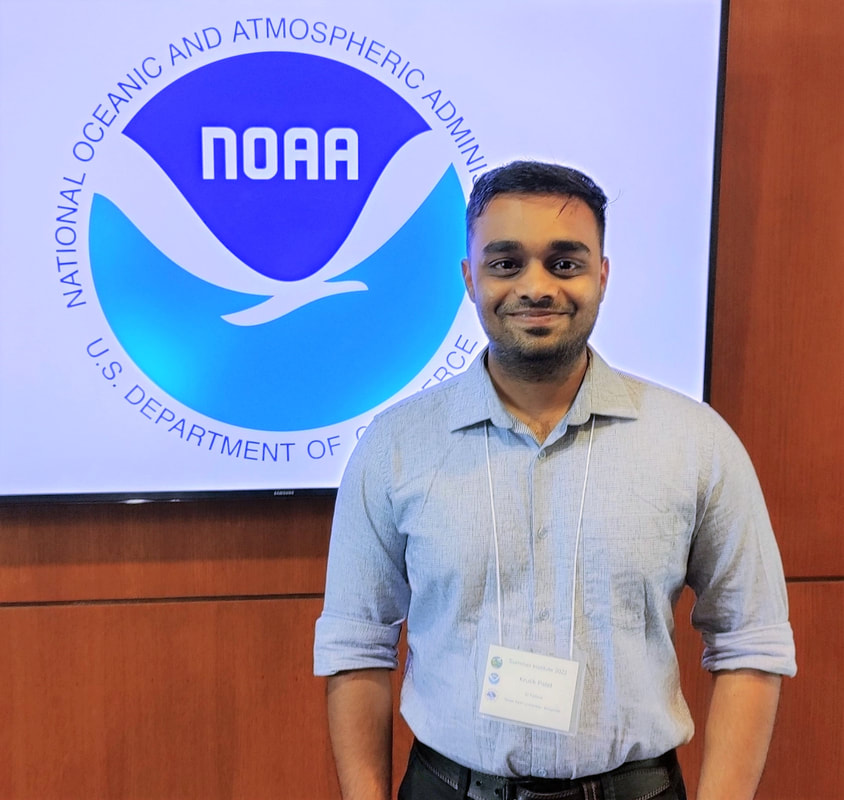
​PhD student Krutik Patel starts a summer research position as the 
NOAA National Water Center Innovators Program Fellow. He will work on improved floodplain and channel representation in hydrologic models. See the Linkedin news here.
Picture

Picture
May 15, 2022
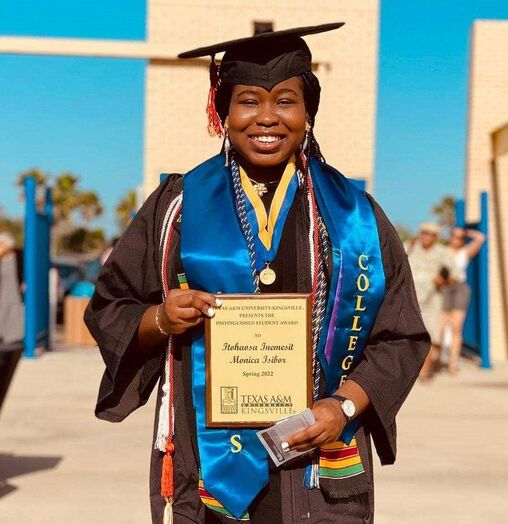
Undergraduate Research Assistant Itohaosa Isibor has been named as the recipient of the Texas A&M University, Kingsville Honors College Distinguished Student Award. Her research on global floodplain alterations led to this highly competitive recognition. Itohaosa will continue working with us as a Graduate Research Assistant from Fall 2022.

January 9, 2022
​Our work to develop a new water quality modeling framework has been featured by NASA Earth Information System. This is the first framework capable of using Earth Observations for modeling human impacts on water pollution across continental-scales. See NASA's story map here. 

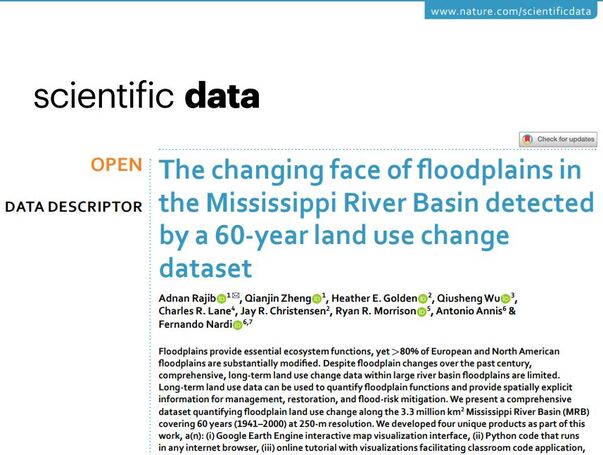
October 15, 2021:  Our most recent paper in Nature Scientific Data is the first to show how humans are altering natural floodplains in the Mississippi River Basin. This is also our PhD student Qianjin Zheng's first publication! 
Picture

October 5, 2021:  Dr. Rajib has been awarded a new federal grant from the US Department of the Interior - Bureau of Reclamation. 

October 1, 2021:  A great kick-off of our coastal resilience project. This project is funded by the NOAA Coastal Management Program - Texas General Land Office. The H2I Lab will integrate Earth Observations and field measurements to understand how native plants can enhance sand dunes and reduce the impacts of sea level rise. Dr. Rajib is a Co-Investigator of this project.
Picture
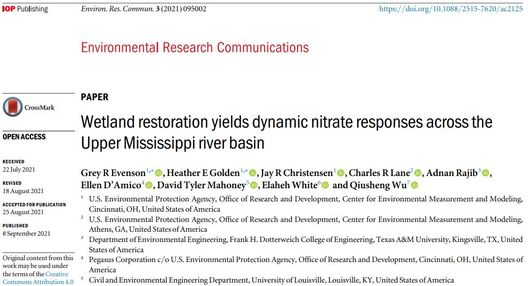
September 8, 2021:  How does restoring natural infrastructures reduce water pollution? We present a unique perspective in the Environmental Research Communications (Impact Factor 2.1). 

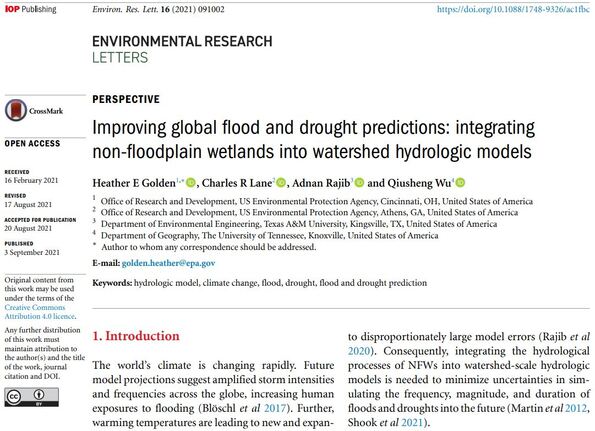
September 3, 2021:  Our collaborative work with the US EPA has just been published in the Environmental Research Letters (Impact Factor 6.8). We discussed the importance of integrating non-floodplain wetlands in conventional flood modeling practices. 
Picture

Picture
July 20, 2021: Our paper in Water Resources Research was among the top 10% most downloaded articles of 2020! This is the first study integrating natural infrastructure storage in a large-scale hydrologic model. 

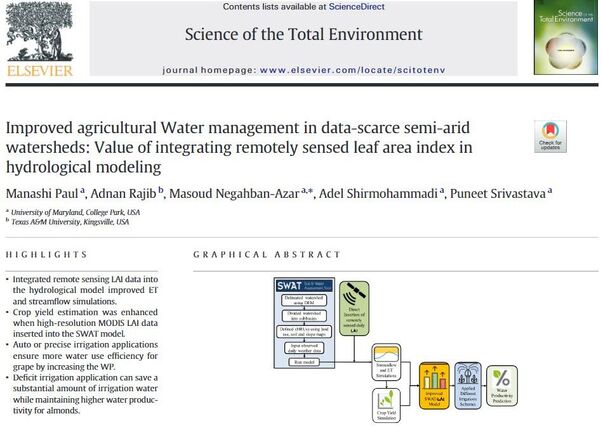
June 1, 2021: New paper alert! Another paper featuring our remote sensing-integrated hydrologic modeling approach just got published in the Science of the Total Environment journal (Impact Factor 7.9). A great outcome of our collaboration with the University of Maryland, College Park! 
Picture

Picture
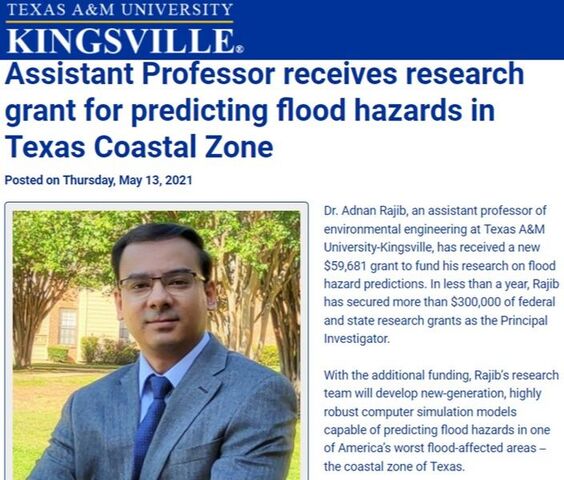
May 13, 2021: Dr. Rajib received a new grant for flood hazard modeling in Texas Coastal Zone! With this grant, the H2I Lab will collaborate with federal, state, and local agencies to develop a new flood mapping workflow. See this news article!

April 26, 2021:  How do you teach climate and flood risk in classroom lectures using real-life data? We did this! Our work received the Fostering Pathways to Success Undergraduate Course Redesign Award through the US Department of Education!

April 1, 2021: Congratulations to PhD student Qianjin for receiving a National Science Foundation fellowship! 

January 1, 2021: The H2I lab welcomes a new PhD student Krutikkumar Patel! 

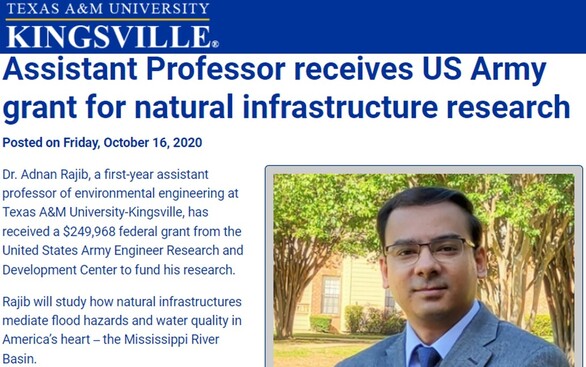
October 16, 2020: Dr. Rajib receives a $250,000 grant from the US Department of Defense for natural infrastructure research! See this news article!
Picture

Picture
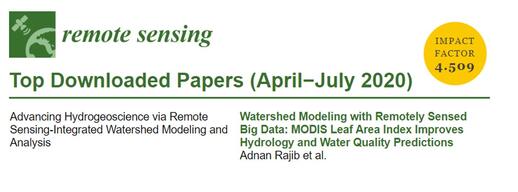
August 5, 2020: Our recent paper in Remote Sensing journal is now among the top most downloaded articles! See this LinkedIn post!

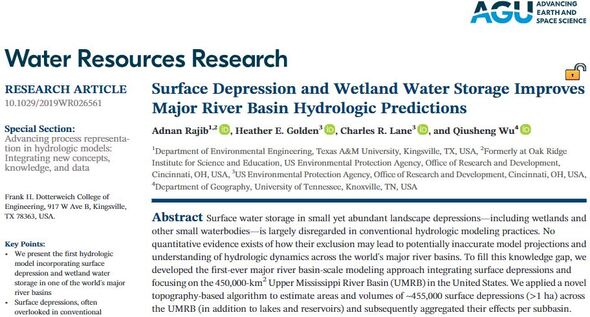
July 6, 2020: Just in! Our new paper in Water Resources Research (Impact Factor 4.4) is the first study integrating numerous surface depression storage in a large-scale hydrologic model.
Picture
  • Home
  • Team
  • Research
  • Publications
  • Tools & Tutorials
  • News
  • Media